The British rarity that is a lifelong local here
In early June, a Western Reef Heron turned up in the harbour at Caernarfon, north Wales: the first record of the species in the entire history of British ornithology. Hundreds of birders crossed the country within hours to see it. The scene is not unusual: in the world of birdwatching, a single out-of-range bird can mobilise an entire community.
And it is not an isolated event. The British Trust for Ornithology (BTO) documented something similar with the Little Egret, a species that until the 1980s was only an occasional visitor to the UK and now exceeds 1,000 breeding pairs — an expansion that their own research in the journal British Birds attributes to increasingly mild winters. The Climatic Atlas of European Breeding Birds (Huntley et al., 2008) had already projected this pattern on a continental scale: Mediterranean species pushing their range limits northward, year after year.
Here, in the Albufera de Valencia, we have the exact reverse of that story.
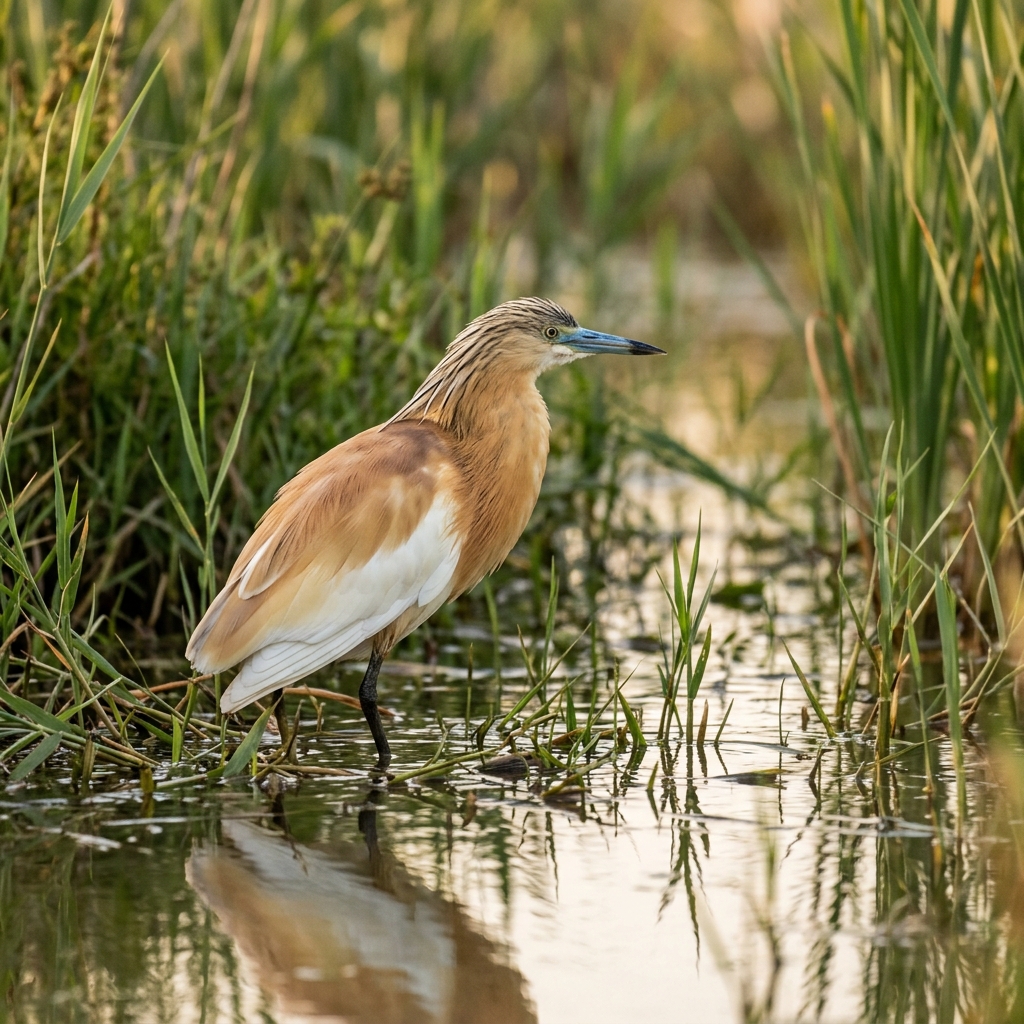
The Squacco Heron (Ardeola ralloides) is one of the most discreet and striking herons of the Mediterranean — ochre and cream plumage at rest that transforms into an almost entirely white bird in flight — and the Albufera holds one of its three main breeding strongholds in Spain, alongside the Ebro Delta and Doñana. It breeds in the reedbeds of the natural park from late April, with clutches extending into July, and forms mixed colonies alongside other herons.
For a British birder, seeing a Squacco Heron is exactly what seeing that Western Reef Heron in Caernarfon was: a rarity that demands planning, luck and, quite probably, a rarities committee assessing the record afterwards. For us, it is a neighbour that returns every summer — like the Bee-eater that nests on the nearby banks, or the Black-headed Gull that bustles in the surrounding colonies.
Why visit the Albufera in late summer
The birding moment
When the extreme heat of July begins to ease, the Albufera enters one of its most interesting phases. The colonies of Squacco Herons, egrets and Glossy Ibises are in full post-breeding dispersal: juveniles of the year move with the adults across rice paddies and channels, and activity at feeding areas multiplies. It is a short window — Squacco Herons begin their return journey to Africa from August onwards — and an especially good one for observation.
The setting
It is also the time of year when the landscape changes. The rice fields shift from deep green to the golden tones that precede the harvest, the light contrast over the water is among the best of the year for photography, and temperatures, though still warm, allow you to enjoy outings without the oppressive heat of peak August. There are also fewer visitors than in high season.
Where and how to find it
The Squacco Heron is discreet by nature — it camouflages itself among reeds and dense vegetation — and locating it requires knowing not only the species, but the specific corners of the natural park where colony activity is most visible at each stage of the season. These are spots you do not reach by chance or with a generic map: they form part of the itinerary that is only shared in the field, with a guide.